RTP vs volatility 2026: two numbers that do different jobs
RTP tells you how much of every bet a slot pays back over the long run. Volatility tells you how that money comes back: in many small wins, or in rare big ones.
They answer different questions, and one does not predict the other. In Pragmatic Play's own figures, low and very high volatility slots share the same typical RTP: 96.50%.
 By Owen Sheridan · Updated
RTP vs volatility: the difference
RTP is the average return to player. A 96.50% RTP slot means a player, on average, gets €96.50 back for every €100 wagered in the long run.
Volatility is the spread around that average. In the UK Gambling Commission's words, in a high-volatility game, players can expect to win "very large but rare" prizes. A low-volatility game, on the other hand, pays out "small and often".
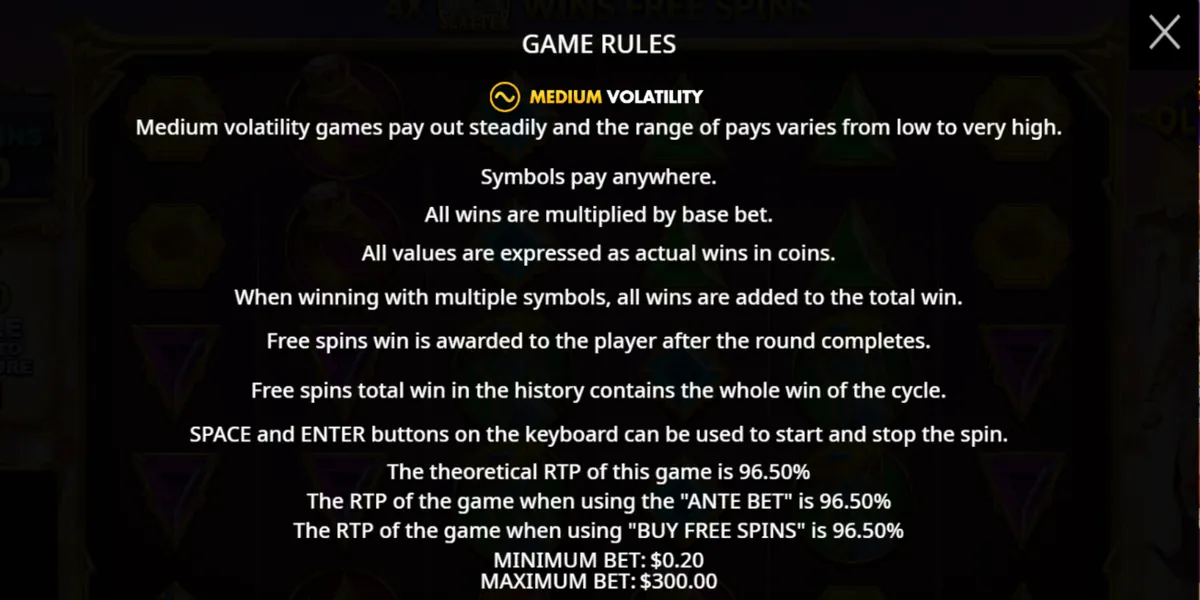
Both can sit on the same rules screen. Gates of Olympus states its volatility at the top of page 4 and its RTP near the bottom.
Where each studio puts these figures: how to check slot RTP.
RTP vs volatility in 594 Pragmatic Play slots
Pragmatic Play lists all its slots as Low, Medium, High or Very High volatility. Looking at Pragmatic Play's 594 labelled slots in this manner shows what changes and what stays the same.
"Typical" is the median of each group, using the top RTP version of each slot.
The typical RTP stays the same at 96.49% to 96.50% for the four groups. The typical max win grows fourfold from Low to Very High volatility. This shows volatility alters the size of the prizes, not the share paid back.
What the top prizes look like across studios: max win slots.
How often slots pay anything at all: hit frequency in slots.
- Low · 70 slots
Typical RTP 96.50%. Typical max win 2,050x the bet.
- Medium · 108 slots
Typical RTP 96.50%. Typical max win 5,050x the bet.
- High · 212 slots
Typical RTP 96.49%. Typical max win 5,000x the bet.
- Very High · 204 slots
Typical RTP 96.50%. Typical max win 8,150x the bet.
Same RTP, different volatility: 1,000 spins
With the same RTP, volatility decides how far one session can stray. The sum is the one the UK Gambling Commission gives casinos for checking their games.
Take three slots, all at 96%, and 1,000 spins at €1. The low-volatility one normally returns between about €836 and €1,084. The high-volatility one can return almost nothing, or almost double.
Same average, very different nights. That is why a high-volatility slot needs a bigger budget for the same number of spins.
How far results stray at other session lengths: theoretical vs actual RTP.
Where 95% of 1,000-spin sessions land, all at 96% RTP
- Low volatility (SD 2)83.6% to 108.4%
- Moderate (SD 5.6)61.3% to 130.7%
- High volatility (SD 15)3% to 189%
SD is the standard deviation per spin. 5.6 is the figure in the Commission's own example; 2 and 15 are illustrations. The dark line is the 96% RTP.
RTP vs volatility in four Pragmatic Play slots
The same pattern in single games: similar RTPs, very different ceilings. The labels and figures are Pragmatic Play's.
Sweet Bonanza shows that the label is only a summary. It is rated Medium, yet its top prize is over 21,000 times the bet.
Pragmatic Play's RTP variations apply whatever the volatility: Big Bass Bonanza also comes at 95.67% and 94.50%. More on Pragmatic Play casinos and the variations they run.
| Slot | RTP | Volatility | Max win |
|---|---|---|---|
| Big Bass Bonanza | 96.71% | Medium | 2,100x |
| Sweet Bonanza | 96.49% | Medium | 21,175x |
| Gates of Olympus 1000 | 96.50% | Very High | 15,000x |
| Typical Very High slot | 96.50% | Very High | 8,150x |
RTP vs volatility: which matters more?
They affect different decisions. RTP determines the average loss, which in turn, decides where you play: the casino running the best version of the game.
Volatility determines how bumpy the ride is, which decides which game fits your budget and patience. Neither replaces the other.
In the short run, volatility determines the end result. In the long run, RTP plays a more dominant role, because luck evens out and the RTP gap does not.
Casinos that run the top RTP versions: best payout online casinos.
- Pick the volatility for your budget
Low for long sessions on a small budget, high only if you can ride long losing runs.
- Pick the game
Within the volatility, pick a game whose top version has a high RTP.
- Pick the casino
Play where that version is offered; check RTP in the rules.
Volatility vs RTP in bonus buys
Bonus buys show the two numbers pulling apart. In Wanted Dead or a Wild, Hacksaw labels the three bonus buys medium, very high and high volatility, respectively.
The top versions of the buys have RTPs of 96.27%, 96.33% and 96.43% respectively. The price and the swing change, the payback barely does.
Whether buying the bonus pays back more: bonus buy RTP.

RTP vs volatility FAQ
What is the difference between RTP and volatility?
RTP is the average share of money bet that a slot returns. Volatility is the size and frequency of deviations from that average: frequent small wins or rare big ones.
Do high-volatility slots have a higher RTP?
Not in Pragmatic Play's catalogue. Its Low, Medium, High and Very High slots all have a typical RTP of about 96.50%.
Is RTP or volatility more important?
When choosing a casino, RTP is more important, but over the course of a session, it is usually volatility that determines the outcome.
Does volatility change with the RTP version?
Pragmatic Play assigns the same volatility to all versions of the same game. Big Bass Bonanza is rated Medium, whether a casino runs it at 96.71% or 94.50%.
Which volatility is best for a small budget?
Low or medium. With the same RTP, a low-volatility slot keeps sessions close to the average, and makes the budget last longer.
What does a high max win say about volatility?
Usually that the slot is volatile, since the money for the rare large prizes is taken from lots of smaller results. The rating is a summary: Sweet Bonanza is rated Medium with a top prize of 21,175x.